Great trekking to mera peak with guides Durga and Indra from Himalayan Vacation. Very friendly and competent guides. Despite extreme cold one of us made it to the top, the other one to base camp of Mera Peak Thanks for a fantastic 3 weeks!
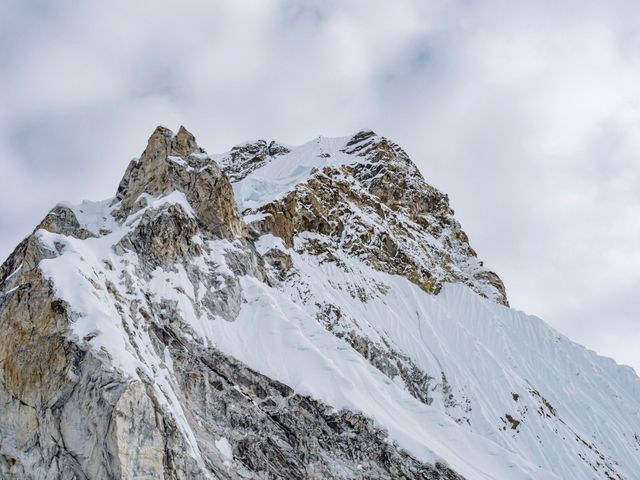
Mera Peak
- Duration 19 Days
- Max altitude 6476m
- Difficulty Challenging
- Group size 2-12 Pax
- Best season Spring & Autumn
- Stay Tea House + Camping
Nepal’s highest trekking peak
Mera peak is Nepal’s highest trekking peak and therefore a popular destination for many hikers who want to reach new heights without technical mountaineering skills. This makes it easier to climb than other peaks in the Makalu Barun National Park. Although the climb is not technically difficult, it requires physical strength and basic mountaineering skills. Prior to the ascent, an HV Treks climbing guide will provide a briefing and a short training to prepare for the summit day.
In this itinerary, the trek will start in the village of Lukla, which we travel to Ramechhap from Kathmandu by jeep and fly to Lukla. The trek itself will take 17 to 18 days, depending on weather conditions.
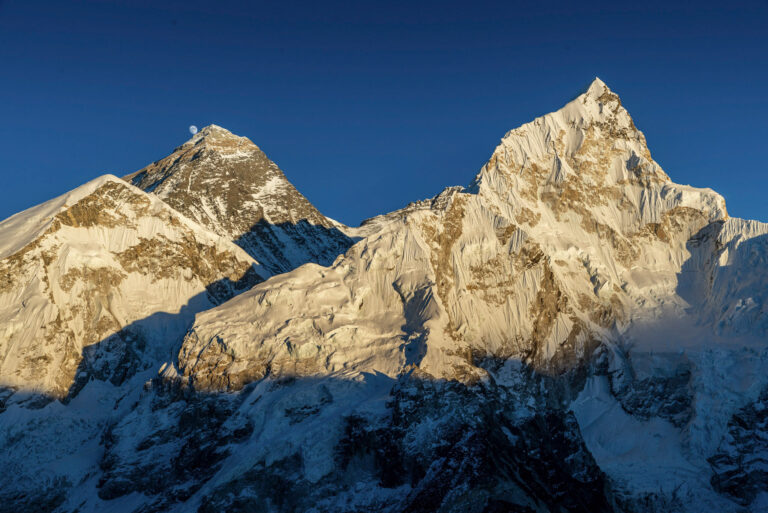
At our high camp, the sweeping view of Kanchanjangha, Chamlang and Makalu to the east, Everest and Lhotse to the north and Amadablam and Cho-Oyu to the west is incredible. The view is considered one of the most stunning in all of Nepal. Because the successful summiting of high elevation peaks is weather dependent, the treks’ itinerary may have to be adjusted to accommodate a safe ascent. The trek ends in Lukla, from which we fly to Kathmandu.
- Summit Mera Peak at 6,461 m
- Spectacular high-Himalayan panoramas
- Scenic Kathmandu-Lukla–Kathmandu flight
- Himalayan Sherpa culture
- Thrilling first 6,000 m peak
- Guided climbing support & expedition team
Best time to go
- J
- F
- M
- A
- M
- J
- J
- A
- S
- O
- N
- D
- Best
- Good
- Not Recommended
Difficulty
Challenging
Demanding high-altitude adventures involving long days, remote terrain, high passes or mountaineering sections that may require specialised equipment. Strong fitness and previous high-altitude or relevant climbing experience are recommended.
Day by day
Day01 Arrival in Kathmandu 1400m Airport transfer
Welcome to Kathmandu, the vibrant capital of Nepal, renowned for its historical monuments, sacred Hindu temples, and serene Buddhist monasteries. Upon your arrival at Tribhuvan International Airport, one of our company’s representatives will be there to greet you. They will hold a display board with your name and “Himalayan Vacation Treks and Expedition” clearly written on it. After a warm welcome, you will be escorted to your hotel, where you can relax and unwind. The evening is yours to enjoy at your leisure, with dinner on your own to explore the city’s diverse culinary delights.
Day02 Sightseeing in Kathmandu 1400m 5-6 hours
A tour guide according to the need of our guests will be provided. The guide takes the guests for sightseeing in Kathmandu. The sightseeing includes Pashupati area, Boudhanath and Swoyambhunath area. The time for sightseeing begins after breakfast; it goes generally 9.00am to 4.00pm. On the same day, the company makes the permit and does other paper works for the trekking. Lunch and dinner will be on your own.
Day03 Kathmandu – Lukla - Chutanga 3440m 3-4 hours
Today, we fly from Kathmandu. If airport in Kathmandu became air traffic congestion, then we will fly from Ramechhap after driving 3-4 hours from Kathmandu. Today’s flight can be compared with mountain flight. If sky is clear we can see snowcapped Himalayan Mountain peaks in north and terrace field in the south with doted settlement. It is about 35minet from Kathmandu and about 20minet flight from Ramechhap. After landing in Lukla we start our first day of the trek, we have an easy walk which leads eastwards. The path from here is less regular than the other main trails from Lukla. The trekking crosses through a number of small villages and wood yards until we reach a thick forest of silver fir, birch, pines and rhododendron trees and bushes on the hillside below Nau Lekh also known as Kalo Himal Ridge. In this part of the trek, we are warned to follow the guide or better we be in the group as there are many paths leading away from the main trail. There are many small streams on the route. The whole of this area referred to as Chutanga which is a summer meadow for the Yaks especially. We visit the surroundings of Chutanga and spend the night here.
Day04 Chutanga – Thuli Kharka via Zwatra La 4610m 4-5 hours trek
We continue our trek the next day from Chutanga, the adventure begins with a steep climb to cross the Kalo Himal Ridge in the Nau Lekh range which separates the Khumbu from the Hinku Valley. A steep uphill climb brings us to a cairned notch in the rim with a collection of Buddhist prayer flags at 4,450m. This small pass is called the Zatrwa Og, from here the path traverses across a boulder slope, round a corner and climbs once again to the Zatrwa-La at 4,610 m. In bad weather to find the path of our route can be quite misleading, so we need to be careful. During the fine weather, the views across the Dudh Kosi towards Karyolung and the Lumding Himal are very impressive, as well as the scenery across the rolling foothills of the Hunku Valley. From here within less than an hour we reach Thuli Karkha where we spend the night.
Day05 Thuli Kharka – Kote 3640m 4-5 hours trek
Today we walk down to the Inkhu Khola. In the beginning, we follow a stretch of the ridge of the mountain, a bit up and down. After crossing a pass, we have a good view of the southwest wall of Mera Peak and Sannu Himal. Now we walk above the tree line in the beginning, but during the day we vanish into the jungle with rhododendrons and blue Himalayan pine. The descent is steep and slippery. We reach the rough river along which we walk now. After some time, we reach in Kote and spend night at lodge.
Day06 Kote – Thangnag 4358m 3-4 hours trek
Now we walk through the wreckage along Inkhu Khola and continue to the north into the valley. A few years ago, Sabai-Tsho, a glacial lake broke and the resulting flood caused huge damage in the Hunkhu valley. Just before Tangnag lies a small Gompa where we bring a final sacrifice to pray for the success of climbing. During the quiet climb up, we will have a view of the Kyashar (6770 meters). The valley becomes narrower and is stuck between the Kusum Kang Guru and Mera West. Thangnag is situated in the big and spacious meadows.
Day07 Acclimatization day at Thangnag 4358m Rest Day
Today, we’ll embark on an acclimatization hike to a cairn situated on the flank of Kusum Kanguru (5,270m). From this vantage point, we’ll be rewarded with sweeping views across the Hinku Valley and striking close-ups of Mera’s north and central summits. The panorama includes majestic mountains, sprawling glaciers, winding rivers, and—if we’re lucky—we might even witness a distant avalanche. A stunning mountain lake also comes into view, and we’ll catch a glimpse of our next destination from this breathtaking spot.
Day08 Thangnag- Khare 5000m 2-3 hours trek
The environment is getting rougher around us now. We walk along the side of moraine of the glacier Dig. We walk heading to Khare that furnish the base camp. Now, the weather, snow conditions and the physical condition of the individual climbers play a vital role ahead. Here we need to take an ultimate decision on the logistical and technical approach of the next three days. One thing is definite; the nights will be severe cold and the height and tension of the climb we probably will not let us sleep well too.
Day09 Acclimatization and practice of the climbing day 5000m Rest Day
One more acclimatization and climb practice before we climb the peak. Khare is the starting point for the climb of Mera Peak. This is the last place with lodges, mainly for carriers, and tent pitches on terraces next to the cabins. We can eat indoors and carriers are well protected. When we are higher up on the mountain to climb, they will be here every day to return to. In the morning, we will continue with extensive exercises with the equipment, with the rope and prusiken to go to a fixed rope up and down. Those who wish can still make a trip to the higher ground in the afternoon. Himalayan Vacation Treks and Expedition guide will make arrangement for the day.
Day10 Khare – Mera La Camp 5415m 3-4 hours trek
Today we cross the Mera Glacier and walk to the Mera La camp. This is located on the eastern side of the pass at 5344 meters. The first part is slightly steep so we may have to put a fixed rope here. The main part of the journey on the glacier, however, is slightly sloping. The campsite is situated near a small lake and is rocky and small. The porters carry only the necessary food supplies and materials for the climb up and go back to Khare BC.
Day11 Mera La Camp – High Camp 5780m 2-3 hours trek
Our porters come up again and bring all our equipment to High Camp. There is not too much space for camping so we need to measure and set our tents. The view from here is a pair of seven and eight-thousand high peaks such as Kanchenjunga, Chamlang, Makalu, Baruntse, Lothse, Cho Oyu and Everest course. This site is considered for one of the most beautiful viewpoints of Nepal. We make camp on the glacier, which means dig and chop, which is very laborious at this altitude and again a very cold night.
Day12 Climbing Mera (Central) Peak and descent to base camp Khare 6461m 7-8 hours trek
Today is the day of goal, or let’s say, the day of truth; the day of those who come out on the top. Far before the dawn, in the darkness of the night, we get up and get ready for the climb. It will be a long journey across the icy landscape. The slope is not very steep and there are not many gaps. Despite highly facilitated technically, the difficulty takes great effort in every meter in this height. A little wind can thereby already provide very low temperatures so we must be alert to frostbite. All these inconveniences, however, are quickly forgotten when we reach the top and certainly if we wish; we can report the base camp regarding our success. We don’t remain for longer than 30 minutes on the top. The weather won’t allow us to remain longer. We climb down slowly and to the base camp of Khare.
Day13 Khare – Kote 3640m 4-5 hours trek
From Khare, we directly go back to Khote since it will not be difficult for us to go down and we don’t need acclimatization. We need acclimatization while going up only. Hence, going down is done almost constantly. We can share our experiences, tell our stories of climbing, to the expeditors who are going up and they, for sure, will listen enthusiastically to our findings and recommendations. We head to Kote for the night.
Day14 Kote – (Chhatra la) 4320m 5-6 hours trek
We are slowly going to the known steep track through the forest until we reach the meadows of Thuli Kharka. We must be ready for tomorrow since a steep climb and a steep descent are waiting for us. We spend the night in Thuli Kharka.
Day15 Thukikharka- Lukla 2840m 7 hours trek
Our final day of trekking brings its own challenges as we tackle a series of ridges leading up to the Zatrwa La Pass. The terrain here is rugged, offering breathtaking views of both the Hinku Valley and the southern face of Mera. From the pass, we descend past Zatr Og, a prominent rocky outcrop, before continuing downhill into the Dudh Koshi Valley. The trail transitions back into lush, forested terrain, eventually opening up to the cultivated farmlands surrounding Lukla. This dramatic shift in scenery provides a striking contrast to the remote and rugged landscapes we’ve experienced over the past few days.
Day16 Extra Day Extra Day Extra Day
This is the reservation day that we can use if we encounter bad weather during the summit attempt or if we are delayed, for example due to problems with the flights.
Day17 Lukla – Kathmandu 1400m 1-2 hours flight
Today we wait for the plane to fly Kathmandu/Ramechhap. Who knows, we will come back to this region again or not in our life. So, we may have look around for the last view of the Everest region. The flight depends on the weather condition. Flight delay or cancellation is common phenomenon in this region. So, we may have to pay extra charge (US $ 350-450) for the plane charter so that we will not miss our flight to our home country from Kathmandu.
Day18 Rest/Shopping in Kathmandu, Bhaktapur Sightseeing 1400m 3 -4 hours
This day you spend on your own either looking around Kathmandu, buying a souvenir for your friends/family or you can have full rest or prepare for going back to your home country. Or if you wish you can be taken to Bhaktapur for sightseeing for 4 hours (extra charges apply). In the evening you will be served the Farewell Dinner by the company.
Day19 Departure from Kathmandu 1400m Airport Transfer
Himalayan Vacation Treks and Expedition representative will manage vehicle and staff to drop our valuable guests at the airport and bid goodbye. It will be not only goodbye to you but also the welcome for next visit to Nepal.
A steady, well-paced climb
Altitude profile
Highest point reached each day, in metresView as table
| Day | Highest point | Altitude |
|---|---|---|
| Day 1 | Kathmandu | 1400 m |
| Day 2 | Kathmandu | 1400 m |
| Day 3 | Chutanga | 3440 m |
| Day 4 | Zwatra La | 4610 m |
| Day 5 | Kote | 3640 m |
| Day 6 | Thangnag | 4358 m |
| Day 7 | Thangnag | 4358 m |
| Day 8 | Khare | 5000 m |
| Day 9 | Khare | 5000 m |
| Day 10 | Mera La Camp | 5415 m |
| Day 11 | High Camp | 5780 m |
| Day 12 | Mera (Central) Peak | 6461 m |
| Day 13 | Kote | 3640 m |
| Day 14 | Chhatra la) | 4320 m |
| Day 15 | Lukla | 2840 m |
| Day 16 | Extra Day | 2840 m |
| Day 17 | Kathmandu | 1400 m |
| Day 18 | Kathmandu | 1400 m |
| Day 19 | Kathmandu | 1400 m |
Clear pricing, no surprises
Included
- Airport pickups and drops in a private vehicle
- Farewell dinners in Kathmandu
- Hotel accommodation in Kathmandu with breakfast
- Lodge teahouse trek accommodation during the trek
- Accomodation during trek
- 2 night 3 days in high camp including camping meals and camping accomodation
- Welcome and farewell dinners
- All domestic flight(14 seater)
- All ground transportation on a comfortable vehicle as per the itinerary
- Trained English speaking trekking guide and climbing guide with assistants
- Porter service (2 trekkers: 1 porter)
- Staff costs including their salary, insurance, domestic airfare, food and accommodation
- Himalayan Vacation treks and expedition trekking bag/12kg capacity bag and trekking map are yours to take
- Makalu Barun National Park fee
- All necessary paper work;and trekking permits .
- Mera Peak climbing permit
- Kitchen equipments and tents for climbing.
- Medical kit (carried by your guide)
- All government and local taxes
Not included
- Nepalese visa fee 15 Days – 30 USD 30 Days – 50 USD 90 Days – 125 USD
- Excess baggage charge(s)
- Extra night accommodation in Kathmandu because of early arrival, late departure, early return from mountain (due to any reason) than the scheduled itinerary
- Lunch and evening meals in Kathmandu
- All meals (breakfast, lunch and dinner) during the treks
- International flights
- Travel and rescue insurance
- Emergency Evacuation (Helicopter Rescue)
- Entrance fees for sightseeing/monument visits as per the itinerary
- Down jacket and sleeping bag and trekking Hiking shoes ,Climbing shoes .
- Personal expenses (phone calls, laundry, bar bills, battery recharge, extra porters, bottle or boiled water, shower, etc.)
- Oxygen or altitude Chamber (PAC)
- Tips for guides and porters
Good to know
1. Do I need previous mountaineering experience to climb Mera Peak?
You don’t necessarily need extensive mountaineering experience, but basic climbing skills are important. HV Treks includes acclimatisation and climbing practice at Khare before the summit attempt, while its climbing programme covers skills involving crampons, ropes and ice axes.
2. What makes summit day so demanding?
The challenge is primarily altitude, cold and endurance. The HV Treks itinerary climbs from High Camp at around 5,800 m to Mera Central at 6,461 m, with an estimated 8–10 hour summit and descent day.
3. What mountains can I see from Mera Peak?
The panorama is one of Mera Peak’s greatest rewards. HV Treks highlights views toward Kanchenjunga, Chamlang and Makalu in the east, Everest and Lhotse to the north, and Ama Dablam and Cho Oyu to the west.
4. What happens if the weather prevents our summit attempt?
Flexibility is built into the expedition. The HV Treks Mera Peak-Phaplu itinerary includes an extra day, and HV Treks notes that the schedule may be adjusted when weather conditions affect the possibility of a safe summit.
5. Is Mera Peak a trek or a climbing expedition?
It’s really a combination of both. Much of the journey is a multi-day Himalayan trek, but the final section becomes a mountaineering objective requiring appropriate equipment, acclimatisation and climbing techniques. This makes Mera a natural progression for experienced trekkers wanting to attempt their first 6,000-metre-class Himalayan peak.