Pisang Peak
- Duration 16 Days
- Max altitude 6,091m
- Difficulty Challenging
- Group size 4-12 Pax
- Best season Spring & Autumn
- Stay Tea House + Camping
Step beyond trekking onto snow and ice, reaching a spectacular 6,091-metre summit above the Manang Valley.
Rising to 6,091 metres above the Manang Valley, Pisang Peak offers an exciting transition from high-altitude trekking into genuine Himalayan mountaineering. Positioned above the famous Annapurna Circuit, the journey brings together traditional mountain communities, the landscapes of the upper Marsyangdi Valley and the challenge of standing on a snow-covered 6,000-metre summit.
The HVTreks Pisang Peak Climbing programme has been designed around progressive altitude exposure rather than rushing directly towards the mountain. Beginning with an overland journey through the lower Marsyangdi Valley, the route gains elevation steadily before reaching Upper Pisang at 3,300 metres.
An additional acclimatisation day at Upper Pisang allows climbers to hike higher and return to sleep lower before making the substantial ascent towards Base Camp. This gradual progression becomes increasingly important as the itinerary moves beyond normal trekking elevations.
At Pisang Peak Base Camp at 4,380 metres, the nature of the adventure changes. Trekking gives way to mountaineering, and the HVTreks climbing team introduces and refreshes the skills needed higher on the mountain.
Training covers movement with crampons, ice-axe technique, fixed ropes, ascenders and rappelling. These are practical skills rather than ceremonial training: Pisang Peak’s summit route enters genuine snow and ice terrain and may require fixed-line movement on steeper upper sections.
From Base Camp, climbers ascend to High Camp at 5,400 metres, where the focus turns fully towards the summit attempt. The night is spent organising equipment, hydrating and resting before an early start.
Summit morning begins before dawn. The route climbs progressively higher into snow and ice, with the upper slopes steepening towards Pisang Peak’s summit ridge. Reaching the 6,091-metre summit opens an extraordinary panorama across the Annapurna Himalaya, with views towards Annapurna II, Annapurna IV, Gangapurna and neighbouring Himalayan peaks.
Reaching the summit is only half the objective. Climbers must descend carefully to Base Camp before the HVTreks itinerary returns through the Manang Valley.
Pisang Peak is particularly well suited to physically fit trekkers with previous high-altitude trekking experience who want to progress into mountaineering. Previous technical climbing experience is valuable but does not necessarily need to be extensive. The dedicated Base Camp training provides an opportunity to learn or refresh the techniques needed for the ascent.
It is important, however, not to underestimate the mountain simply because it is often described as a trekking peak. At more than 6,000 metres, cold, reduced oxygen, long climbing days, steep snow and changing mountain conditions make preparation and sound judgement essential.
For adventurous trekkers who are ready to progress beyond the trail, HVTreks Pisang Peak Climbing offers a natural introduction to 6,000-metre Himalayan mountaineering, combining a genuine summit objective with the culture and scenery of Nepal’s Annapurna region.
- Reach a 6,091-metre Himalayan summit
- Climb in the prime spring or autumn season
- Journey overland through the Annapurna landscape
- Experience the mountain culture of Manang
- Take your first steps into Himalayan mountaineering
- Professional climbing and high-altitude support
Best time to go
- J
- F
- M
- A
- M
- J
- J
- A
- S
- O
- N
- D
- Best
- Good
- Not Recommended
Difficulty
Challenging
Demanding high-altitude adventures involving long days, remote terrain, high passes or mountaineering sections that may require specialised equipment. Strong fitness and previous high-altitude or relevant climbing experience are recommended.
Day by day
Day01 Arrival in Kathmandu 1,400 m Airport Transfer
Arrive at Tribhuvan International Airport, where the HVTreks team will welcome you and transfer you to your hotel. Meet the team and rest after your international journey.
Day02 Kathmandu Valley Sightseeing and Climbing Preparation 1,400 m Full day
Explore some of Kathmandu Valley's cultural and historical highlights before focusing on the climb ahead. Later, meet the HVTreks team for the expedition briefing, personal equipment check and final climbing preparations. This is also an opportunity to resolve any gear requirements before leaving Kathmandu.
Day03 Drive from Kathmandu to Tal 1,700 m 6-7 hrs drive
Leave Kathmandu and travel towards the Annapurna region. The road follows river valleys through terraced farmland, traditional settlements and changing hill landscapes, with distant views towards Ganesh Himal, Manaslu and other Himalayan ranges in clear weather. After reaching Besisahar, continue deeper into the Marsyangdi Valley to Tal.
Day04 Trek from Tal to Koto 2,610 m 5-6 hrs trek
Begin the trekking section with a physically rewarding day through pine forest and rugged mountain terrain. Long climbs, stone steps and uneven trails are balanced by waterfalls, suspension bridges, rushing rivers, terraced hillsides and glimpses towards Annapurna II. Reach Koto for the night.
Day05 Trek from Koto to Upper Pisang 3,300 m 5-7 hrs trek
Continue through the upper Marsyangdi Valley, passing through Chame, the administrative centre of Manang District. Walk beside the river and through mountain settlements and apple-growing areas before reaching Upper Pisang. The village reflects the Tibetan-influenced culture of Manang and provides impressive views of the surrounding Annapurna mountains.
Day06 Acclimatisation at Upper Pisang 3,300 m 4-5 hrs hike
Spend an important day allowing your body to adjust before moving significantly higher. Hike into the surrounding terrain to gain additional altitude, then return to Upper Pisang to sleep lower. This controlled exposure prepares the body for the climb towards Pisang Peak Base Camp.
Day07 Trek to Pisang Peak Base Camp 4,380 m 5-6 hrs trek
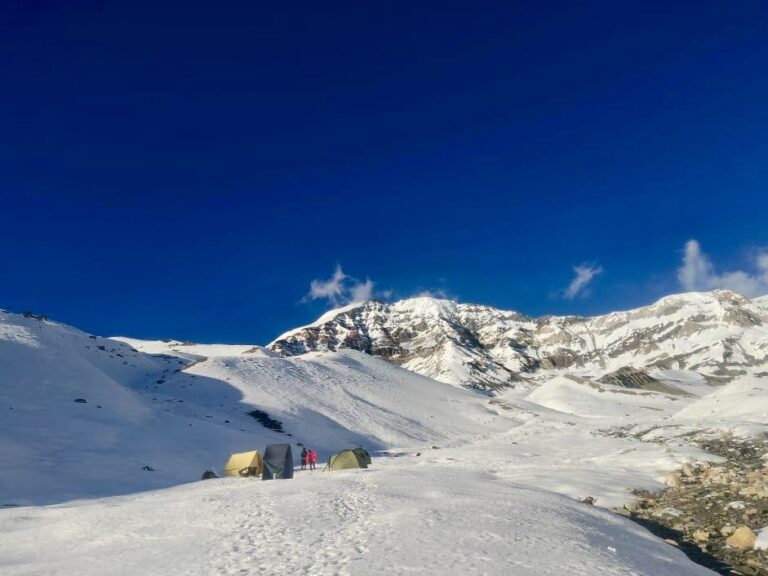
Leave the main settlement and climb above Upper Pisang through increasingly sparse vegetation and open alpine terrain. The landscape becomes progressively wilder as the route approaches Pisang Peak. Reach Base Camp at 4,380 metres and settle into the expedition camp beneath the mountain.
Day08 Acclimatisation and Climbing Training at Base Camp 4,380 m Full day
Rest and acclimatise while shifting the focus from trekking to mountaineering. The HVTreks climbing team provides practical preparation covering crampons, ice-axe use, fixed ropes, ascenders, rappelling and safe movement on snow and ice. Equipment is checked and organised before the move to High Camp.
Day09 Pisang Peak Base Camp to High Camp 5,400 m 4-6 hrs climb
Leave Base Camp and climb through increasingly rugged alpine and glaciated terrain towards High Camp. The significant gain in altitude makes a controlled pace important. Reach High Camp at 5,400 metres, hydrate, organise climbing equipment and rest ahead of the early summit start.
Day10 Pisang Peak Summit and Return to Base Camp 6,091 m 10-12 hrs climb
Begin before dawn and climb into the upper mountain. Snow and ice become increasingly prominent as the route rises towards Pisang Peak's summit ridge, with fixed ropes used where required by terrain and conditions. Reach the 6,091-metre summit and enjoy an extraordinary Himalayan panorama before carefully descending through High Camp and returning to Base Camp. Pisang Peak's upper route involves snow slopes and fixed climbing sections, making suitable equipment and mountaineering preparation necessary.
Day11 Summit Contingency Day 4,380 m Full day
Keep one full day flexible for weather, snow conditions, climber health or operational delays. If the summit is completed according to schedule, the day can be used for recovery at Base Camp. If conditions require a delay, HVTreks can reposition this day within the climbing programme rather than relying on a single predetermined summit opportunity.
Day12 Trek from Base Camp to Manang 3,540 m 5-6 hrs trek
Leave the climbing environment behind and descend towards the Marsyangdi Valley before continuing to Manang. The lower elevation provides welcome recovery following the summit effort, while Manang offers an opportunity to experience one of the upper Annapurna region's most distinctive traditional settlements.
Day13 Drive from Manang to Besisahar 760 m 5-6 hrs drive
Travel by jeep from Manang towards Besisahar. The rugged mountain road descends through alpine forest and scattered settlements before following the Marsyangdi Valley into progressively greener terrain. Reach Besisahar, the principal gateway to this side of the Annapurna region.
Day14 Drive from Besisahar to Kathmandu 1,400 m 6-7 hrs drive
Continue from Besisahar towards Kathmandu, initially following the Marsyangdi River towards Mugling before joining the Trishuli corridor and Prithvi Highway. Travel time can vary depending on road and traffic conditions. On arrival in Kathmandu, transfer to your hotel and rest.
Day15 Rest, Shopping and Optional Bhaktapur Sightseeing 1,400 m Full day
Enjoy a free day for recovery, shopping or personal exploration in Kathmandu. If you wish, HVTreks can arrange an optional 3-4 hour sightseeing visit to historic Bhaktapur at additional cost. In the evening, join the HVTreks team for a farewell dinner and celebrate your Pisang Peak achievement.
Day16 Final Departure from Kathmandu 1,400 m Airport transfer
Prepare your travel documents and personal belongings for departure. An HVTreks representative will transfer you to Tribhuvan International Airport approximately three hours before your flight. Leave Nepal with the experience of Manang, Pisang Peak and your 6,091-metre Himalayan summit behind you.
A steady, well-paced climb
Altitude profile
Highest point reached each day, in metresView as table
| Day | Highest Point | Altitude |
|---|---|---|
| Day 1 | Kathmandu | 1,400 m |
| Day 2 | Kathmandu | 1,400 m |
| Day 3 | Tal | 1,700 m |
| Day 4 | Koto | 2,610 m |
| Day 5 | Upper Pisang | 3,300 m |
| Day 6 | Upper Pisang Acclimatisation Hike | 3,800 m |
| Day 7 | Pisang Peak Base Camp | 4,380 m |
| Day 8 | Pisang Peak Base Camp | 4,380 m |
| Day 9 | Pisang Peak High Camp | 5,400 m |
| Day 10 | Pisang Peak Summit | 6,091 m |
| Day 11 | Pisang Peak Base Camp | 4,380 m |
| Day 12 | Manang | 3,540 m |
| Day 13 | Besisahar | 760 m |
| Day 14 | Kathmandu | 1,400 m |
| Day 15 | Kathmandu | 1,400 m |
| Day 16 | Kathmandu | 1,400 m |
Clear pricing, no surprises
Included
- Airport transfers: Private airport pick-up and drop-off.
- Kathmandu hotel: Three nights’ hotel accommodation in Kathmandu with breakfast.
- Welcome dinner: Welcome dinner as part of the HVTreks programme.
- Permits: Pisang Peak climbing permit, applicable NMA fees and Annapurna Conservation Area Permit.
- Garbage management: Applicable garbage deposit and transportation fees.
- Staff insurance: Medical and emergency-rescue insurance for Nepalese staff.
- Map: Trekking and climbing map.
- Duffle bag: HVTreks expedition duffle bag.
- Transportation: Comfortable vehicle according to the itinerary.
- Equipment transportation: Transportation of expedition equipment from Kathmandu to Manang by jeep and onwards to Base Camp by porter or mule.
- Member baggage: Up to 24 kg of personal luggage per member, carried by porters.
- Camping: 4 nights / 5 days of camping, including camping meals.
- Trekking guide: Government-licensed trekking guide throughout the trekking section.
- Climbing guide: Government-licensed climbing guide from Base Camp to the summit and back.
- Gear assistance: Climbing-guide assistance with carrying climbing equipment to the high camps.
- Climbing-guide costs: Salary, food, equipment and clothing for the climbing guide.
- Base Camp and High Camp services: Tents, lighting, cooking gas, cooking equipment, high-altitude food, ropes and necessary group climbing equipment.
- Two members share one tent at High Camp.
- Weather forecast: Weather information throughout the climbing programme.
- Guide leader: Team leadership and management of safety and logistics.
- Assistant guide: Support for the team leader, clients and camp setup.
- Cook: Camping cook responsible for preparing meals during the camping section.
- Kitchen staff: Assistance with meal preparation and transport of kitchen equipment.
- Porters: One porter for every two trekkers, with additional porters where operationally required.
- Medical kit: Basic medical kit for members and staff.
- Climbing certificate: Applicable climbing certificate following a successful ascent.
Not included
- International flights: Flights to and from Kathmandu.
- Nepal visa: Nepal entry visa. Your supplied package lists US$50 for a 30-day visa; because government fees can change, this should be rechecked before publication.
- Kathmandu meals: Lunch and dinner during your stay in Kathmandu.
- Trekking meals: Three meals per day during the teahouse trekking section are not included.
- Additional hotel nights: Extra accommodation caused by early arrival, late departure, early return, road delays, cancellations or changes outside the scheduled itinerary.
- Personal travel insurance: Comprehensive insurance covering medical treatment, high-altitude rescue, helicopter evacuation, trip cancellation/interruption and repatriation is mandatory.
- Personal expenses: Phone calls, internet, toiletries, battery charging, hot showers, laundry, soft drinks, beer and alcoholic beverages.
- Personal climbing equipment: Clothing, bags, packing items, personal medical supplies and personal trekking/climbing equipment.
- Toiletries: Soap, shampoo, toilet paper, toothpaste and other personal-hygiene items.
- Filming permits: Special filming, professional camera and drone permit fees where applicable.
- Internet: Internet services during the trek and climbing period.
- Summit bonus: US$300 to $350 for the climbing guide following a successful summit.
- Tips: Minimum recommended contribution of $50 to $100 for High Camp and other supporting staff.
- Other expenses: Any service, activity or expense not specifically listed under Price Includes.
Good to know
1. Is Pisang Peak suitable for my first 6,000-metre climb?
It can be, particularly for fit trekkers who already have good high-altitude trekking experience and want to progress into mountaineering.
HVTreks includes a dedicated Base Camp training day covering crampons, ice axe, fixed ropes, ascenders and rappelling before moving to High Camp.
However, Pisang Peak is still a genuine 6,000-metre mountain with steep snow and ice terrain, so good physical preparation and respect for altitude are essential.
2. Why does HVTreks include an acclimatisation day at Upper Pisang?
Upper Pisang sits at 3,300 metres, while Base Camp is at 4,380 metres, creating a significant altitude gain.
Rather than moving immediately higher, HVTreks spends an additional day at Upper Pisang so climbers can hike above the village and return to sleep lower. This gives the body more time to respond to altitude before the climbing section begins.
3. What makes summit day different from normal trekking?
Summit day starts before dawn from High Camp at 5,400 metres and enters snow and ice terrain where mountaineering equipment becomes necessary.
Depending on conditions, climbers may use:
crampons;
ice axe;
harness;
ascender;
fixed ropes; and
other safety systems.
The upper slopes become steeper towards the summit ridge, making the day significantly more demanding than ordinary trekking.
4. What happens if weather prevents the summit attempt on Day 10?
HVTreks keeps Day 11 as a dedicated summit contingency day.
If poor visibility, snowfall, wind, route conditions or climber health makes the planned summit attempt unsuitable, the climbing team can reposition the schedule.
The extra day improves flexibility, but it does not guarantee a summit. If conditions remain unsafe, HVTreks will prioritise a safe descent over forcing an ascent.
5. How does Pisang Peak compare with Yala Peak and Ama Dablam?
Pisang Peak sits naturally between the two within the HVTreks climbing progression.
Yala Peak is an introductory Himalayan summit below 6,000 metres.
Pisang Peak introduces climbers to a 6,091-metre summit, High Camp, snow and ice and more sustained mountaineering systems.
Ama Dablam is a considerable step beyond Pisang, involving sustained exposed technical climbing on rock, snow and ice.
For an adventurous trekker looking to develop gradually, a sensible HVTreks progression is:
Yala Peak → Pisang Peak → Island/Lobuche → Chulu East → Ama Dablam → 7,000 m expeditions
You may also like
Chulu Far East Peak
Rise above the Manang Valley onto snow and high Himalayan terrain for an unforgettable 6,059-metre summit. Some Himalayan climbs are memorable because of the…
Himlung Himal Expedition
Journey through a hidden Himalayan valley and rise beyond 7,000 metres into a world of snow, glaciers and remote mountain wilderness. Hidden beyond the…
Chulu Far East Peak via Nar phu Valley
Cross the hidden valleys of Nar Phu and Kang La before rising onto a 6,059-metre summit above the Annapurna Himalaya. Some Himalayan climbs are…